I've realised something rather odd - I have a tendency to start my novels with a mission statement (for want of a better description). Now, I'm only on my second novel as we speak but it's happened both times so a pattern seems to be forming.
In both instances I've written a page or two that sort of sets out the themes and content in a slightly overwritten way that sounds reminiscent of a voice-over from the opening of a film. The mission statement disappeared from the first novel in the third draft, when I became comfortable with the opening. I'm starting to work towards ditching the one from the new book too.
It's an odd little habit that possibly says something about how little I know of what's going to happen in the book before I start writing.
Anyone else ever done this?
Cheers,
Matt

Showing posts with label book #2. Show all posts
Showing posts with label book #2. Show all posts
Wednesday, 22 June 2011

Friday, 20 May 2011
Why I'm not sending my novel to any more agents
I finished my first novel Not Falling Off in October and began the submission process. I drew up a shortlist of agents who represented authors whose work I love, read the Writers and Artists Yearbook carefully so I knew how best to approach the process (and what I needed in terms of synopsis, covering letter etc) and waited to be snapped up.
Now, seven months later, I can tell you there has been no snapping. I managed to get a few agents to read the first three chapters and got standard rejections from most. A couple came within 24 hours of me following up on the original submission so I'm sure they hadn't read it. Most, however, I think had. You can't blame agents for using standard templated letters with the amount of stuff they have to read.
Four asked for and read the whole thing. The response was pretty good overall. Words used included: interesting, authentic, well-crafted, evocative, engaging, touching - yet nobody wanted to take it on. I even bumped into one of the agents a month or two later and, unprompted, she introduced herself and spent 15 minutes telling me (in detail) all the things she loved about the book. I was a bit baffled. Still, onwards and upwards. Luckily I had an idea already bubbling away for book 2 so threw myself into that in the meantime while I waited for the last agent to get back to me.
The final 'no thanks' came early this week and, oddly, I was rather pleased. Let me explain why. A month ago I was lucky enough to do a three day Intensive Fiction Workshop course at the Faber Academy. By the end of the first day my head was spinning with all the insight we'd been given and I immediately knew my book was weak in places. That came as a bit of a shock. On the second day I explained this to one of the course tutors (Trevor Byrne) who said, if he was in my position, he'd just crack on with the book I was now writing. He was right. I already know this book will be better based on what I've learned since I finished the first and I'm actually glad nobody took me on.
Even better, a couple of the agents who read Not Falling Off and liked it have said they're happy to read book 2 when it's finished.
I will go back and look at Not Falling Off once I'm finished with this book but not before.
So, patience is the key. If you want a sustained career in writing (and we all do, right?) it might just pay to wait til your writing catches up with your ambitions. Maybe not, you might write a splendid first book - I hope so.
I've also listened to a couple of podcast interviews with other writers recently whose first novel (or novels) didn't get published and are, with hindsight, rather pleased. These include Chris Cleave and David Mitchell (not that I'm in any way comparing myself to two such amazing writers).
Lesson learned. I'm now 15,000 words into the new book so we'll see where that takes me.
Thanks for reading
Matt
Now, seven months later, I can tell you there has been no snapping. I managed to get a few agents to read the first three chapters and got standard rejections from most. A couple came within 24 hours of me following up on the original submission so I'm sure they hadn't read it. Most, however, I think had. You can't blame agents for using standard templated letters with the amount of stuff they have to read.
Four asked for and read the whole thing. The response was pretty good overall. Words used included: interesting, authentic, well-crafted, evocative, engaging, touching - yet nobody wanted to take it on. I even bumped into one of the agents a month or two later and, unprompted, she introduced herself and spent 15 minutes telling me (in detail) all the things she loved about the book. I was a bit baffled. Still, onwards and upwards. Luckily I had an idea already bubbling away for book 2 so threw myself into that in the meantime while I waited for the last agent to get back to me.
The final 'no thanks' came early this week and, oddly, I was rather pleased. Let me explain why. A month ago I was lucky enough to do a three day Intensive Fiction Workshop course at the Faber Academy. By the end of the first day my head was spinning with all the insight we'd been given and I immediately knew my book was weak in places. That came as a bit of a shock. On the second day I explained this to one of the course tutors (Trevor Byrne) who said, if he was in my position, he'd just crack on with the book I was now writing. He was right. I already know this book will be better based on what I've learned since I finished the first and I'm actually glad nobody took me on.
Even better, a couple of the agents who read Not Falling Off and liked it have said they're happy to read book 2 when it's finished.
I will go back and look at Not Falling Off once I'm finished with this book but not before.
So, patience is the key. If you want a sustained career in writing (and we all do, right?) it might just pay to wait til your writing catches up with your ambitions. Maybe not, you might write a splendid first book - I hope so.
I've also listened to a couple of podcast interviews with other writers recently whose first novel (or novels) didn't get published and are, with hindsight, rather pleased. These include Chris Cleave and David Mitchell (not that I'm in any way comparing myself to two such amazing writers).
Lesson learned. I'm now 15,000 words into the new book so we'll see where that takes me.
Thanks for reading
Matt
Tuesday, 22 March 2011
The pen is not mightier than the words
I just filled the first notebook of scribblings for my second novel so have started another - the notebooks in question cost £3.99 each from Ryman. I mention this because when I started writing I was convinced I needed a posh notebook - you know the sort, the type of notebook that lets people 15 feet away know you're writing something IMPORTANT when you're sitting in a coffee shop. Moleskine is the bare minimum acceptable.
I also spent hours in WH Smith looking at pens. Now, don't get me wrong, it's important to have a good pen, especially if (like me) you write your first draft longhand. I did realise, fairly quickly thank goodness, that the time I was spending lurking in shops, fingering the spines of expensively decorated notebooks, would be better spent writing or reading.
The pen I use costs £1.99, the notebook twice as much and I do have a favourite pencil. If you like fancy notebooks then buy one - if you want an expensive fountain pen, go ahead. Don't spend too long on these things though as they soon become displacement activities. Get some paper, get a pen, get writing.
The pen is not mightier than the words.
I also spent hours in WH Smith looking at pens. Now, don't get me wrong, it's important to have a good pen, especially if (like me) you write your first draft longhand. I did realise, fairly quickly thank goodness, that the time I was spending lurking in shops, fingering the spines of expensively decorated notebooks, would be better spent writing or reading.
The pen I use costs £1.99, the notebook twice as much and I do have a favourite pencil. If you like fancy notebooks then buy one - if you want an expensive fountain pen, go ahead. Don't spend too long on these things though as they soon become displacement activities. Get some paper, get a pen, get writing.
The pen is not mightier than the words.
Tuesday, 30 November 2010
Books: Robert McKee - Story
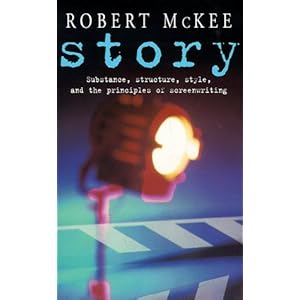
Story: Substance, Structure, Style and the Principles of Screenwriting

Over the past 18 months or so I've listened to a lot of podcasts featuring authors talking about their work. I've also read a lot of author interviews and, unsurprisingly, plenty of books about writing. Almost all of the books have contained at least one nugget of inspiration or usefulness - some far more. One has proved absolutely indispensable - so much so that I bought the audiobook as well so I can listen to sections on the go.
Robert McKee's Story is aimed at screenwriters and, as such, uses examples from the world of film to illustrate its points. Don't let that put you off if you're a novelist - this book is simply a masterclass in the art of telling a story and telling it well.
McKee manages to strip away the layers and get right to the heart of what drives great storytelling - the gap between expectation and reality. By examining the structure of story (from the overall arc of the work to the reversals of each scene) he manages lay out some simple points to consider that will tell you where to go - if you listen.
That doesn't mean that Story is a step-by-step guide to writing a great screenplay or novel - far from it. What the book does is allow you to see the patterns, devices and structures used in great storytelling and shed some light on why the best writing is so effective.
I've read the whole book at least three times and, whether through selective re-reading or via headphones, must have covered some sections half a dozen times. I'm at the planning stages of my second novel - if I can build and sustain a career doing this I can only see those numbers growing.
The best £12 I've spent since realising I wanted to write.
Buy it now.
Tuesday, 16 November 2010
Calling all opera singers...
Having finished my first novel and sent it out to agents I've been keeping myself busy by starting work on a second. The main character of this book will be an opera singer (lyric soprano with a tendency towards Mozart & Strauss in case you're wondering).
I know quite a bit about opera and am busy reading up on singers and singing technique but could really do with some input from people who either sing themselves or work with singers (repetiteurs, coaches, conductors etc). I'm interested in hearing from people at all points of their career - whether just starting out, auditioning for jobs, establishing a career, bringing the house down at the Met or whatever - anything can and will prove useful!
So, if you're an opera singer or work with singers and would be prepared to spend 10-15 mins answering a few questions then email me and I'll send you a short list. Let me know who you are and what you do when you get in touch so I can send you relevant questions.
Apologies for using a graphic version of my email address (making it tricky to cut and paste) - it saves me from getting loads of spam from bots trawling the web and picking up email addresses

I know quite a bit about opera and am busy reading up on singers and singing technique but could really do with some input from people who either sing themselves or work with singers (repetiteurs, coaches, conductors etc). I'm interested in hearing from people at all points of their career - whether just starting out, auditioning for jobs, establishing a career, bringing the house down at the Met or whatever - anything can and will prove useful!
So, if you're an opera singer or work with singers and would be prepared to spend 10-15 mins answering a few questions then email me and I'll send you a short list. Let me know who you are and what you do when you get in touch so I can send you relevant questions.
Apologies for using a graphic version of my email address (making it tricky to cut and paste) - it saves me from getting loads of spam from bots trawling the web and picking up email addresses

Cheers in advance
Matt
Friday, 15 October 2010
Stepping out of the city in zone 3
I love living in London. There's so much to do - for a start I have 2 opera houses (not to mention the Wigmore Hall, Barbican, South Bank and even a new pub opera house). There are also countless cool shops, bars, cafes and restaurants. It's an amazing place to be - I sometimes wish I didn't live here so I could see it for the first time again (although the view of St Paul's or the Houses of Parliament lit up at night from one of the bridges over the Thames always manages to give me a tiny bit of that feeling).
Sometimes though I want to feel like I'm not in a city at all. That's fine at weekends as I can always go away or just drive out on a Sunday and go for a walk somewhere. What if I want to go for a walk in the woods in the morning before I go to work though? Living in zone 3 in south east London you wouldn't expect too many options would you? I certainly didn't when I moved here.
Then I found this...

Literally a 5 minute walk from my house is a stretch of woodland big enough to walk through for at least 40 minutes without seeing a road! When I first moved here I worked from home so used to walk in the woods quite a bit at lunchtime. When I started my first novel I used to spend hours in there listening to podcast interviews with writers, desperately looking for any clues as to how on earth you're supposed to write a novel. Now I'm on book 2 I've found that getting up and walking before work in the mornings and doing the same really helps get my head back into the ideas stage of the process.
The wood is apparently tiny compared to the area it covered in the 19th century, but it's still a little pocket of the English countryside by my door and that is a blessing.
Sometimes though I want to feel like I'm not in a city at all. That's fine at weekends as I can always go away or just drive out on a Sunday and go for a walk somewhere. What if I want to go for a walk in the woods in the morning before I go to work though? Living in zone 3 in south east London you wouldn't expect too many options would you? I certainly didn't when I moved here.
Then I found this...

Literally a 5 minute walk from my house is a stretch of woodland big enough to walk through for at least 40 minutes without seeing a road! When I first moved here I worked from home so used to walk in the woods quite a bit at lunchtime. When I started my first novel I used to spend hours in there listening to podcast interviews with writers, desperately looking for any clues as to how on earth you're supposed to write a novel. Now I'm on book 2 I've found that getting up and walking before work in the mornings and doing the same really helps get my head back into the ideas stage of the process.
The wood is apparently tiny compared to the area it covered in the 19th century, but it's still a little pocket of the English countryside by my door and that is a blessing.
Tuesday, 5 October 2010
Books: Songs of Triumphant Love - Jessica Duchen

Songs of Triumphant Love

I'd already read Jessica Duchen's Hungarian Dances and very much enjoyed it. When I started the research for my 2nd novel I had stumbled upon Jessica on Twitter and thought, as an author and music writer, she may be able to point me in the direction of some good novels that featured opera singers, so fired off a quick Tweet. I soon got several replies mentioning books she thought I should read, plus "my latest, Songs of Triumphant Love, is about an opera singer." So I ordered a copy.
Having read the blurb I instantly worried that Jessica had already beaten me to it and written the book I had in mind ("feel the fear and do it anyway!" she was kind enough to encourage). Only one way to find out - I started reading.
Now, first up, there are two things wrong with this book - neither is the fault of the author. The first is the jacket design which, while beautiful, is entirely intended to make the book look as close to The Time Traveller's Wife as possible. The second is the blurb. I know its hard to sum up a novel in a few words but the summary on the back cover really doesn't do justice to the breadth and depth of this book. If I'd picked it up in a bookshop, never having heard of Jessica, I'd probably have put it back, thinking it was likely to be a bit...well...floppy!
No so. This is a wonderful book that somehow manages to do what a good book should; it takes a personal story, complicates it with inter-personal relationships then offsets the whole thing against the extra-personal to connect with the wider world. Songs of Triumphant Love pokes a hole in the fabric of the universe (like the crack in Terri's front wall or the rip in her silk dress) and lets us peer in, allowing the reader one of those rare moments that can only be achieved by art in which we see that (as Walt Whitman would have us believe in Song of Myself) we are all part of a bigger picture and nothing is in or of itself alone.
Cracks (in walls, dresses, sanity, voices) are a powerful image. As Leonard Cohen puts it "Forget your perfect offering, there is a crack in everything, that's how the light gets in."
I loved this book. I've realised that, while mine will probably have some overlap in terms of theme and setting, it's going to be a totally different novel and is worth writing for its own sake. It will, undoubtedly, be a better book than it would had I not read Songs of Triumphant Love.
Monday, 4 October 2010
Disc of the Day #19 - Dvorak - Russalka

Dvorák - Rusalka

I've had a copy of this knocking about for ages now and never got round to listening to it so, as a result, all I really knew of the opera was the famous 'Song to the Moon'. I've got a soft spot for folksy and/or myth-related opera anyway (e.g. Der Freischutz, Smetana's Bartered Bride, Hansel und Gretel, Tristan..., Orff's Der Mond and so on) so it should be up my street.
I have to say I'm loving it so far (on first couple of listens). There's something about the old state-run labels (Melodiya, Hungaroton and, in this case, Supraphon) that often means you get a great recording complete with good singing and an overall air of authenticity that results in a fantastic first experience of an opera written in the language native to the country in question. There's also a really strong tie-in to the themes of the second novel I'm writing but I'll say no more about that at this point as I have no idea where it's going to end up yet (my first started as a story about a group of five kids who make up their own mythology and ended up as nothing of the sort).
Anyway, I'll keep listening. I suspect I'll only have a better idea of just how much I like the opera once I get a chance to see it in the theatre so here's hoping that chance comes sooner rather than later.
Thursday, 30 September 2010
Has my book already been written?
When I started my first novel 18 months ago it didn't really occur to me that someone else might already have written it. To be honest it didn't really occur to me that I was actually going to finish it.
Now it's done (and lounging in a drawer awaiting one final check before going out to a list of agents) I'm starting research and planning for a second. Almost the first thought I had was 'is this an original idea?'. Almost immediately I discovered at least one book that has alarming parallels (judging from the blurb anyway - my copy should arrive from Amazon later today). Luckily the panic only lasted an hour or so - during which time the author of the book in question tweeted me to say 'feel the fear and do it anyway' after I'd told her I was worried she'd already written my book (she was the one who recommended hers, amongst many others, as being along similar lines).
Luckily the fear only lasted for an hour or so. I'm sure that whatever other people have written there will be more differences than similarities between our books.
What the past few days has highlighted though is just how fragile an idea is and what a nebulous thing a novel is in its early (and even middle) stages.
Now it's done (and lounging in a drawer awaiting one final check before going out to a list of agents) I'm starting research and planning for a second. Almost the first thought I had was 'is this an original idea?'. Almost immediately I discovered at least one book that has alarming parallels (judging from the blurb anyway - my copy should arrive from Amazon later today). Luckily the panic only lasted an hour or so - during which time the author of the book in question tweeted me to say 'feel the fear and do it anyway' after I'd told her I was worried she'd already written my book (she was the one who recommended hers, amongst many others, as being along similar lines).
Luckily the fear only lasted for an hour or so. I'm sure that whatever other people have written there will be more differences than similarities between our books.
What the past few days has highlighted though is just how fragile an idea is and what a nebulous thing a novel is in its early (and even middle) stages.
Tuesday, 28 September 2010
A finished novel and an empty notebook
So, a few days ago I finished the novel I've been writing for the past 18 months. This is brilliant and scary in equal measures as now I have to send it off into the world and find out whether it's crap, brilliant or (more likely) any one of a million things in between. That's partly what it's about though, how we generally live in the between, so it makes sense.
On the very good advice of a mate (Phil Earle, whose brilliant debut novel Being Billy is published in January by Puffin) I'm sticking the manuscript of book #1 in a drawer for a couple of weeks and giving it a final read before it goes out. Seeing as the Frankfurt Book Fair is almost upon us there's a fair chance nobody would read it til the end of October anyway.
In the meantime I've bought a new notebook (just a cheap Ryman's thing, I think the quality of my writing would be likely to be inversely proportional to the fanciness of any notebook I was to buy) and am cracking on with the research and note taking for book #2.
I'll fill you in on any feedback I get once it's out there.
On the very good advice of a mate (Phil Earle, whose brilliant debut novel Being Billy
is published in January by Puffin) I'm sticking the manuscript of book #1 in a drawer for a couple of weeks and giving it a final read before it goes out. Seeing as the Frankfurt Book Fair is almost upon us there's a fair chance nobody would read it til the end of October anyway.In the meantime I've bought a new notebook (just a cheap Ryman's thing, I think the quality of my writing would be likely to be inversely proportional to the fanciness of any notebook I was to buy) and am cracking on with the research and note taking for book #2.
I'll fill you in on any feedback I get once it's out there.
Subscribe to:
Posts (Atom)